


What Size Hydraulic Cylinder Do I Need?
Choosing the correct hydraulic cylinder is about much more than finding a ram that physically fits the machine. The cylinder must produce enough force, provide the required stroke and operate safely at the available hydraulic pressure, while also matching the mounting arrangement and hydraulic circuit.
Whether you are replacing an existing hydraulic ram or designing a new system, understanding bore size, stroke length, rod diameter, operating pressure and cylinder type will help narrow down the correct specification.
If you already know the specification you require, you can browse our hydraulic cylinder range .
Quick answer
To size a hydraulic cylinder correctly, start with the force you need and the hydraulic pressure available. These determine the required piston area and therefore the cylinder bore. You must then confirm the required stroke, rod diameter, closed and open lengths, mounting arrangement, cylinder type and hydraulic flow rate. Do not select a cylinder from load weight or bore size alone.
- 1) What determines hydraulic cylinder size?
- 2) How do I calculate hydraulic cylinder force?
- 3) What bore size hydraulic cylinder do I need?
- 4) Why are push and pull forces different?
- 5) What stroke length do I need?
- 6) Do I need a single or double acting cylinder?
- 7) How do rod size and mounting affect selection?
- 8) How does flow rate affect cylinder speed?
- 9) Hydraulic cylinder sizing example
- 10) Hydraulic cylinder sizing checklist
- 11) Frequently asked questions
1. What Determines the Size of a Hydraulic Cylinder?
Hydraulic cylinder size is normally described using several dimensions rather than one single measurement. Two cylinders with the same stroke, for example, can produce very different forces if they have different piston bore diameters.
Before selecting a cylinder, establish what the cylinder must actually do within the machine.
| Specification | What it affects |
|---|---|
| Required force | Determines how much push or pull the cylinder must generate to move the load. |
| Operating pressure | Works together with piston area to determine the theoretical cylinder force. |
| Bore diameter | Determines piston area and therefore has a major effect on cylinder force. |
| Stroke | Determines how far the piston rod can travel. |
| Rod diameter | Affects retracting force, structural strength and resistance to buckling. |
| Closed and open length | Determines whether the cylinder physically fits the machine throughout its movement. |
| Mounting arrangement | Controls how the cylinder connects to the machine and how the load is transmitted. |
| Flow rate | Influences how quickly the cylinder extends and retracts. |
| Single or double acting | Determines whether hydraulic pressure operates the cylinder in one or both directions. |
How to Measure a Hydraulic Cylinder
If you are replacing an existing hydraulic cylinder, taking accurate measurements can make it much easier to identify a suitable replacement. Important dimensions include the cylinder bore, piston rod diameter, mounting hole diameter, port thread size, stroke length and the distance between the mounting centres when the cylinder is fully retracted and fully extended.
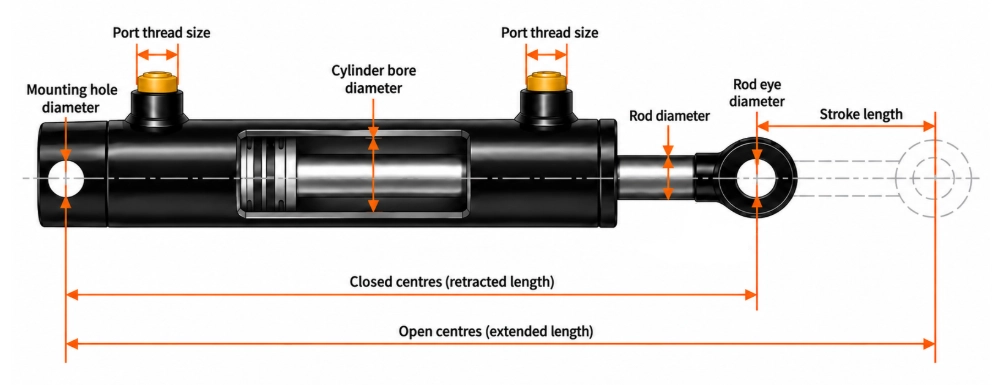
Measurements worth recording
For a replacement cylinder, record the bore diameter, rod diameter, stroke, closed centres, open centres, mounting hole sizes, rod-eye dimensions and hydraulic port thread sizes. Photographs of the existing cylinder and its mounting arrangement can also be useful when checking compatibility.
Start with the application, not the cylinder catalogue
A cylinder should be selected from the force, movement, geometry and operating conditions required by the machine. Choosing a cylinder simply because its dimensions appear close to an existing space can result in insufficient force, poor movement or excessive loading.
2. How Do I Calculate Hydraulic Cylinder Force?
Hydraulic cylinder force is determined by the hydraulic pressure acting over the effective piston area. In simple terms:
Basic hydraulic cylinder force formula
Force = Pressure × Area
When working in bar and square millimetres:
Force (kN) = Pressure (bar) × Piston Area (mm²) ÷ 10,000
The piston area can be calculated from the cylinder bore:
Piston area formula
Piston Area = π × Bore² ÷ 4
This means increasing the cylinder bore produces more force at the same hydraulic pressure because the oil acts over a larger piston area.
Theoretical force is not the same as usable machine force
Calculations based purely on pressure and piston area provide theoretical cylinder force. Real hydraulic systems can experience pressure losses, friction, back pressure and variations in operating conditions. Machine geometry, acceleration, shock loading and the angle at which the cylinder acts can also substantially change the force required. Appropriate design margin should therefore be included for the individual application.
3. What Bore Size Hydraulic Cylinder Do I Need?
The cylinder bore is the internal diameter of the barrel in which the piston operates. It is one of the most important measurements when sizing a cylinder because it determines the piston area.
If the required force and available working pressure are known, the approximate piston area can be calculated first:
Required piston area
Piston Area = Required Force ÷ Available Pressure
The corresponding bore can then be calculated or the next suitable standard cylinder size can be considered. Remember that a theoretical minimum should not automatically be treated as the final cylinder specification.
Approximate Theoretical Push Force by Bore Size
The table below provides a quick comparison of theoretical extension force at several common working pressures. Figures are rounded and do not include efficiency losses, back pressure or application-specific design margins.
| Cylinder bore | 100 bar | 150 bar | 200 bar |
|---|---|---|---|
| 25 mm | 4.9 kN | 7.4 kN | 9.8 kN |
| 32 mm | 8.0 kN | 12.1 kN | 16.1 kN |
| 40 mm | 12.6 kN | 18.8 kN | 25.1 kN |
| 50 mm | 19.6 kN | 29.5 kN | 39.3 kN |
| 60 mm | 28.3 kN | 42.4 kN | 56.5 kN |
| 70 mm | 38.5 kN | 57.7 kN | 77.0 kN |
| 80 mm | 50.3 kN | 75.4 kN | 100.5 kN |
| 90 mm | 63.6 kN | 95.4 kN | 127.2 kN |
| 100 mm | 78.5 kN | 117.8 kN | 157.1 kN |
A bigger bore is not automatically better
Increasing bore size increases available force, but it also increases the volume of oil required to move the cylinder. With the same pump flow, a larger-bore cylinder will generally operate more slowly. Cylinder size therefore needs to be considered alongside hydraulic flow and the required operating speed.
Find a Hydraulic Cylinder to Suit Your Application
Once you have an idea of the bore, stroke and type of cylinder required, you can begin comparing suitable hydraulic cylinders. Flowfit offers single acting, double acting and telescopic cylinders for a wide range of hydraulic applications.
Hydraulic cylinders
Browse the full Flowfit hydraulic cylinder range and compare available bore sizes, stroke lengths and mounting options.
Double acting cylinders
Suitable where controlled hydraulic power is required during both extension and retraction.
Single acting cylinders
Suitable where hydraulic force is required in one direction and the cylinder can return through gravity, load or another external force.
Telescopic cylinders
Designed for applications requiring a relatively long working stroke where the available closed installation length is restricted.
Not sure which cylinder you need?
If you know your required force, operating pressure, stroke and mounting dimensions, the Flowfit team can help identify suitable options for your application.
4. Why Are Hydraulic Cylinder Push and Pull Forces Different?
On a conventional double acting cylinder with a rod on one side of the piston, the available extension and retraction forces are different.
During extension, hydraulic pressure can act across the full piston area. During retraction, the piston rod occupies part of that area, leaving a smaller effective area known as the annulus area.
| Direction | Effective area | Typical result |
|---|---|---|
| Extending / pushing | Full piston area | Higher theoretical force at a given pressure. |
| Retracting / pulling | Piston area minus rod area | Lower theoretical force at the same pressure. |
Retract force calculation
Annulus Area = Piston Area − Rod Area
Retract Force = Pressure × Annulus Area
For example, a 50 mm bore cylinder with a 30 mm rod has substantially less effective piston area on the rod side. At the same pressure, its theoretical pulling force will therefore be lower than its pushing force.
Check which direction carries the important load
If the cylinder must perform its highest-load operation while retracting, size it using the annulus area rather than assuming that its extension force is available in both directions.
5. What Stroke Length Hydraulic Cylinder Do I Need?
The cylinder stroke is the distance the piston rod travels between its fully retracted and fully extended positions.
The required stroke should come from the actual movement needed at the machine rather than simply from the overall space available for the cylinder.
Required movement
Measure how far the attachment, platform, linkage or other mechanism must move between its start and end positions.
Closed length
Confirm the distance available between the mounting points when the cylinder is fully retracted.
Extended length
Check that the machine geometry can accommodate the cylinder when it reaches full extension.
Mechanical limits
Do not rely on the cylinder reaching the end of its stroke to act as an unsuitable mechanical stop for the machine.
Stroke and overall length are not the same thing
A 300 mm stroke cylinder is not necessarily 300 mm long when closed. The barrel, piston, end caps, mounting points and rod-end arrangement all add to the cylinder's overall dimensions.
6. Do I Need a Single Acting or Double Acting Hydraulic Cylinder?
Once the required force and movement are understood, decide whether hydraulic power is required in one direction or both.
| Feature | Single acting cylinder | Double acting cylinder |
|---|---|---|
| Hydraulic force | Applied in one direction. | Applied during extension and retraction. |
| Return movement | Normally provided by gravity, the load, a spring or another external force. | Produced hydraulically. |
| Hydraulic connections | Typically requires one working hydraulic connection. | Typically requires hydraulic connections to both sides of the piston. |
| Common use | Lifting, tipping and applications where the load naturally returns the cylinder. | Applications requiring controlled pushing and pulling in both directions. |
Which type should I choose?
Use a single acting cylinder where hydraulic power is only needed for one working direction and a reliable external return force is available. Choose a double acting cylinder where the machine requires controlled, powered movement in both directions.
7. How Do Rod Diameter and Mounting Affect Hydraulic Cylinder Selection?
Bore and stroke are important, but they are not enough to fully specify a hydraulic cylinder. The piston rod and mounting arrangement must also be suitable for the mechanical loads placed on the cylinder.
Rod Diameter
The rod must be capable of carrying the expected load. This becomes particularly important on long-stroke cylinders where the extended rod is subjected to compression.
A long, relatively slender rod can be vulnerable to buckling when pushing a heavy load, even if the piston itself has enough hydraulic area to theoretically generate the required force.
Mounting Arrangement
Hydraulic cylinders are primarily intended to transmit force along their centreline. Mounting points should allow the cylinder to follow the intended movement without creating unnecessary side loading or misalignment.
| Check | Why it matters |
|---|---|
| Rod diameter | Must withstand the expected tension or compression load. |
| Stroke length | Longer extension can increase the risk of rod buckling under compression. |
| Pin or mounting size | Must be compatible with the machine and capable of transmitting the load. |
| Mounting centres | Must suit both the closed and fully extended machine geometry. |
| Cylinder alignment | Poor alignment can introduce side loading to the rod, seals, bearings and mounts. |
| Load angle | A cylinder acting through a linkage or at an angle may need considerably more force than the load weight suggests. |
Do not size a pivoting cylinder from load weight alone
Tipping bodies, lifting arms, hatches and other pivoting mechanisms act as levers. The force required from the cylinder depends on pivot positions, cylinder mounting points and the changing angle of the cylinder throughout the stroke. The worst-case geometry must be considered when sizing the cylinder.
8. How Does Hydraulic Flow Rate Affect Cylinder Speed?
Pressure and flow perform different jobs within a hydraulic system. Pressure helps determine available force, while flow rate influences cylinder speed.
For a given flow rate, a smaller piston area will generally move faster than a larger piston area. Increasing cylinder bore to obtain additional force without changing pump flow will therefore usually reduce the cylinder's operating speed.
| Change | General effect |
|---|---|
| Increase hydraulic pressure | Increases theoretical cylinder force, provided the system and cylinder ratings permit it. |
| Increase pump flow | Increases cylinder travel speed, subject to component and system limitations. |
| Increase cylinder bore | Increases theoretical force but requires more oil for the same amount of travel. |
| Reduce cylinder bore | Requires less oil to travel at a given speed but produces less force at the same pressure. |
Think about the complete hydraulic circuit
The cylinder, pump, valves, hoses, fittings and reservoir should be considered as one system. A correctly sized cylinder may still perform poorly if the hydraulic power unit cannot provide the required pressure and flow.
9. Hydraulic Cylinder Sizing Example
Consider a simplified example where a cylinder is required to lift a load vertically and directly, without any lever mechanism.
Load
Approximately 3,000 kg, equivalent to roughly 29.4 kN of gravitational force.
Available pressure
150 bar at the cylinder for the purpose of this theoretical example.
Using the theoretical force relationship, a 50 mm bore has a piston area of approximately 1,963 mm².
Theoretical force from a 50 mm bore at 150 bar
150 × 1,963 ÷ 10,000 = approximately 29.4 kN
On paper, this is almost exactly equal to the static load force in this simplified example. That does not mean a 50 mm cylinder should automatically be selected.
A real machine would need to consider additional factors including starting resistance, friction, pressure losses, load variation, acceleration, shock, machine geometry and an appropriate design margin. If the cylinder acts through a lever or at an angle, the required cylinder force may be significantly higher.
A calculation gives you a starting point, not a complete cylinder specification
Final selection must also confirm the cylinder pressure rating, rod strength, stroke, mounting arrangement, duty cycle, hydraulic connections and machine structure. Safety-critical or complex lifting systems should be assessed by a suitably competent designer.
10. What Information Do I Need Before Choosing a Hydraulic Cylinder?
Gathering the information below before looking at cylinder sizes makes selection much easier.
| Information to collect | Why it is needed |
|---|---|
| Application | Establishes what the cylinder is moving and how it operates. |
| Maximum load | Provides a starting point for calculating required cylinder force. |
| Load geometry | Shows whether pivots, levers or changing cylinder angles increase the required force. |
| Available working pressure | Allows the required piston area and approximate bore to be calculated. |
| Required stroke | Determines how far the cylinder needs to travel. |
| Closed and open mounting centres | Confirms whether the cylinder will physically fit through the full movement. |
| Push or pull load | Determines whether full piston area or annulus area is relevant to the critical load. |
| Single or double acting operation | Confirms whether powered movement is required in one or both directions. |
| Required operating speed | Allows cylinder area to be considered alongside the available pump flow. |
| Mounting style and pin sizes | Ensures mechanical compatibility with the machine. |
| Port size and thread | Allows correct connection to the hydraulic circuit. |
| Duty cycle and environment | Helps identify any additional operating, temperature, contamination or service requirements. |
1. Calculate the force
Determine the maximum force the cylinder must produce, including the effects of the machine geometry.
2. Confirm pressure
Establish the realistic working pressure available at the cylinder rather than assuming the maximum system rating.
3. Select the bore
Use force and pressure to determine the required piston area and identify a suitable cylinder bore.
4. Check everything else
Confirm stroke, rod diameter, mounting dimensions, ports, speed, duty and cylinder type before ordering.
11. Hydraulic Cylinder Sizing FAQs
Can I choose a hydraulic cylinder based only on the weight I need to lift?
No. Load weight is only one part of the calculation. You also need to know the available hydraulic pressure and how the cylinder is positioned relative to the load. A cylinder working through a pivot or linkage may need to generate considerably more force than the load's weight.
Does a larger bore hydraulic cylinder produce more force?
Yes. At the same hydraulic pressure, a larger piston area produces greater theoretical force. However, a larger cylinder also requires more oil for each millimetre of movement and can therefore operate more slowly if the pump flow remains unchanged.
What does hydraulic cylinder bore size mean?
Bore is the internal diameter of the cylinder barrel where the piston operates. The bore determines the full piston area used when calculating extension force.
How do I know what cylinder stroke I need?
Determine how far the mechanism must move between its start and finish positions and calculate the cylinder movement required to achieve that travel. Also confirm the closed and extended mounting dimensions.
How do I measure a replacement hydraulic cylinder?
Record the cylinder bore, rod diameter, stroke, closed centres, open centres, mounting hole dimensions and hydraulic port thread sizes. Measure mounting centres from the centre of one mounting point to the centre of the other rather than measuring the overall physical length of the cylinder.
Why does a double acting cylinder have less pulling force?
During retraction, the piston rod occupies some of the available piston area. Hydraulic pressure therefore acts over the smaller annulus area, resulting in lower theoretical force than during extension at the same pressure.
Will increasing hydraulic pressure make my cylinder move faster?
Not directly. Pressure is associated primarily with the force required to overcome the load, while hydraulic flow rate has a major influence on cylinder movement speed.
Can I replace an existing cylinder with one that has the same bore and stroke?
Bore and stroke are important, but they are not the only dimensions that matter. Check rod diameter, closed and open centres, mounting arrangement, pin sizes, port position and thread, working pressure and overall dimensions before treating another cylinder as a direct replacement.
What information should I provide Flowfit when asking for help selecting a cylinder?
Provide as much information as possible about the application, maximum load, operating pressure, required stroke, mounting centres, mounting style, required speed, available flow, cylinder action and hydraulic connection sizes. Details of an existing cylinder or machine drawings can also help when sourcing a replacement.
Choosing the Right Hydraulic Cylinder
The correct hydraulic cylinder needs to provide enough force while also matching the machine mechanically and hydraulically. Bore size is important, but it should always be considered alongside pressure, stroke, rod diameter, mounting geometry, hydraulic flow and the required direction of operation.
Before ordering, confirm:
- The maximum force required from the cylinder
- The realistic hydraulic working pressure available
- The required cylinder bore
- The required stroke length
- The piston rod diameter and loading condition
- Whether the critical load occurs during extension or retraction
- Whether single or double acting operation is required
- The closed and extended mounting dimensions
- The mounting style and pin dimensions
- The required operating speed and available hydraulic flow
- The hydraulic port sizes and thread types
- The duty cycle and operating environment
Find the Right Hydraulic Cylinder for Your Application
Explore Flowfit's range of single acting, double acting and telescopic hydraulic cylinders, or contact our team if you need help identifying the right specification.
Tip: If you are replacing an existing cylinder, have the bore, rod diameter, stroke, mounting centres, pin sizes, port details and working pressure available when contacting the Flowfit technical sales team.
The total one-stop supplier for hydraulic components & systems
Get in touch

Parys Road
Ludlow
Shropshire
SY8 1XY


