


The Ultimate Guide to Hydraulic Hose Fittings: Everything You Need to Know
Understanding Hydraulic Hose Fittings
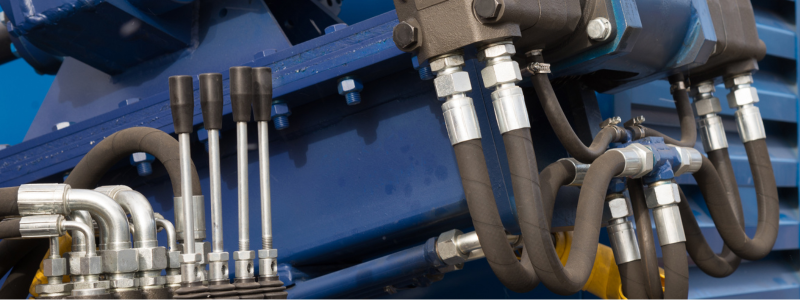
Hydraulic hose fittings connect hydraulic hoses to pumps, valves, cylinders and other components, creating a secure, leak-resistant connection so hydraulic fluid can flow safely under pressure. They also make it possible to match different thread types, hose sizes and connection angles across a wide range of applications.
Looking for hydraulic hose fittings?
If you already know the thread type, hose size, pressure rating and fitting style you need, you can browse Flowfit’s hydraulic hose fittings range.
Shop hydraulic hose fittings | Get help identifying a fitting
Quick takeaway
Flow rate and pressure aren’t the only considerations—choosing the correct thread, seat type and hose size is just as important to prevent leaks.
- How to choose the right hydraulic hose fitting
- Common types of hydraulic hose fittings
- Common thread types for hydraulic fittings
- Fittings vs adaptors: what’s the difference?
- How to measure a hydraulic fitting
- Crimp-on vs reusable fittings
- Can you mix brands?
- What happens if you use the wrong fitting?
- How often should fittings be inspected?
How do I choose the right hydraulic hose fitting?
To choose the correct hydraulic hose fitting, check the following:
- Thread type (e.g., BSP, BSPT, NPT, NPTF, JIC, JIS, SAE, ORFS)
- Hose size (e.g., 1/4", 3/8"—match the hose ID and series)
- Pressure rating (the fitting must meet or exceed system pressure)
- Material (steel, stainless steel or brass depending on corrosion/temperature requirements)
- Seat/seal type (flare, cone, O-ring face seal, bonded seal—must match the mating component)
- Orientation (straight, 45°, 90°, swivel—based on routing and movement)
Tip
Always match both the thread and the sealing method. Some threads look similar but seal differently, which can cause leaks.
Once you know the thread, hose size, pressure rating and fitting angle, browse our hydraulic hose fittings to compare suitable options.
What common types of hydraulic hose fittings are available?
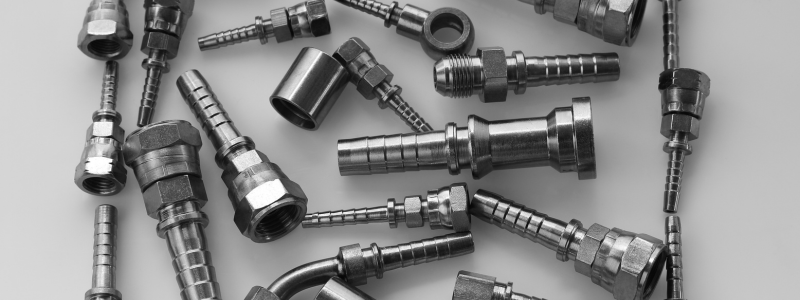
Hydraulic fittings are used across almost every industry. Different fitting shapes are designed for different layouts, space constraints and service access.
- Straight fittings: Direct, in-line connections
- Elbow fittings (45° / 90°): Change hose direction without tight bends
- Swivel fittings: Allow movement/rotation without disconnecting
- Compact fittings: Designed for tight installations
- Banjo fittings: Useful where clearance is limited and a low-profile connection is needed
For straight, angled, compact and specialist fitting styles, view our hydraulic hose fitting range .
What are the most common thread types for hydraulic hose fittings?
Some of the most common hydraulic fitting threads include:
-
BSP (British Standard Pipe) (UK/Europe)
BSPP (Parallel): seals with an O-ring or bonded washer.
BSPT (Tapered): seals through thread deformation when tightened. -
JIC (Joint Industry Council) (common in the US)
37° flare sealing surface for a metal-to-metal seal. -
NPT / NPTF (National Pipe Taper) (common in the US)
Tapered thread profile, seal formed through thread interference. -
Metric threads (common across Europe and globally)
Often seen with DIN standards and metric sealing styles.
Important
Don’t rely on “looks similar” for thread ID. Always measure diameter and pitch, and confirm the seat/seal type.
If you have identified the thread type but need help matching the right connection, browse hydraulic hose fittings or contact Flowfit for support.
What is the difference between hydraulic hose fittings and adaptors?
Hydraulic hose fittings connect the hose to a component (pump, valve, cylinder).
Adaptors connect two different thread types or sizes together—useful when you need to change thread standard without replacing equipment.
If you are replacing the hose-end connection itself, start with our hydraulic hose fittings category.
Steps on how to measure a hydraulic fitting
Measuring a hydraulic fitting correctly helps ensure compatibility and prevents leaks. Here’s a practical step-by-step method.
1) Identify the thread type
- Measure thread diameter:
Use callipers to measure the outside diameter (OD) of a male thread or the
inside diameter (ID) of a female thread.
- Male thread: measure OD across the thread crest.
- Female thread: measure ID across the opening.
- Measure thread pitch: Count threads per inch (TPI) or use a thread pitch gauge for best accuracy.
- Confirm the thread standard: BSP, NPT, JIC and Metric threads use different profiles and sealing methods.
2) Measure the hose ID (internal diameter)
- If possible, remove the fitting and measure the hose ID where the fitting attaches.
- The fitting size must match the hose series and ID (and be rated for system pressure).
3) Determine the fitting style and orientation
- Identify whether it’s male or female, and if it’s straight or angled (45°/90°).
- For swivels/elbows, note the direction and required movement to avoid twisting the hose in service.
4) Measure seat angle / sealing face
- Some fittings seal via seat angles (e.g., JIC 37°, SAE 45°).
- Use a seat angle gauge to confirm the sealing surface type.
5) Measure overall length
- Measure end-to-end length to confirm clearance and installation space.
6) Identify material
- Steel, stainless steel, brass, or aluminium—choose based on corrosion risk and environment.
Tools you might need
- Callipers / vernier calliper (diameter + length)
- Thread pitch gauge (pitch / TPI)
- Seat angle gauge (flare/seat type)
- Thread chart (final confirmation)
Measuring example
If a male fitting measures 9.52 mm (3/8") on the major diameter, it may indicate a 3/8" size for many thread standards. Note: BSP sizing is based on nominal bore (not the major diameter). For example, 3/8" BSP has a major diameter of approximately 16.662 mm.
After measuring, use those details to compare options in our hydraulic hose fittings range .
What’s the difference between crimp-on hydraulic fittings and reusable fittings?
Crimp-on fittings are permanently attached using a crimping machine that compresses the fitting onto the hose. Reusable fittings are designed to be installed and removed multiple times (typically with hand tools), making them useful for field repairs and frequent changes.
Summary of differences
| Feature | Crimp-On Fittings | Reusable Fittings |
|---|---|---|
| Connection type | Permanent | Removable |
| Installation requirement | Crimping machine required | Manual installation (no crimper) |
| Reliability | Very strong, consistent seal | Reliable if installed correctly; can leak if reassembled poorly |
| Flexibility | Best for fixed assemblies | Great for repairs and frequent changes |
| Maintenance | Replace full hose assembly if damaged | Can replace fittings without replacing the hose (where suitable) |
| Cost | Can be higher due to crimping/assembly | Often cost-effective for frequent changes |
For replacement crimp-on and reusable options, browse our hydraulic hose fittings .
Can I mix and match different brands of hydraulic hose fittings?
It’s generally not recommended unless the fittings meet the same standards (ISO/SAE/DIN, etc.) and are known to be dimensionally compatible. Small differences in tolerances can cause poor sealing, leaks, or premature failure.
What happens if I use the wrong hydraulic hose fitting?
Using the wrong fitting can lead to leaks, fitting failure, reduced system efficiency, or in worst cases a catastrophic hose/fitting failure. Always match thread + seal type + pressure rating to your system requirements.
If you are not sure which fitting matches your system, contact our team before ordering.
How often should hydraulic hose fittings be inspected?
Inspect fittings regularly—especially in high-pressure or high-duty applications. Look for wear, corrosion, damaged threads, weeping/leaks, and hose movement that could cause fatigue at the fitting.
Need help identifying a hydraulic hose fitting?
Flowfit can help you identify threads, select the correct fitting, or build a custom hose assembly to your specification. Contact our team for expert guidance, or shop our range of hydraulic hose fittings.
The total one-stop supplier for hydraulic components & systems
Get in touch

Parys Road
Ludlow
Shropshire
SY8 1XY


