


From Field to Function: Understanding Hydraulics in Agriculture
Hydraulics in agriculture help power many of the machines and attachments used on modern farms. From tractors, loaders, sprayers, balers, harvesters, and irrigation systems to barn automation and precision farming equipment, hydraulic systems provide the strength, control, and reliability needed for demanding agricultural work.
This guide explains how hydraulics are used in farming, why hydraulic power is important, the main components in an agricultural hydraulic system, and how to maintain hydraulic equipment to reduce downtime.
Quick answer
Hydraulics are used in agriculture to lift, steer, control, push, pull, raise, lower, fold, and power machinery. Hydraulic pumps, oil, cylinders, motors, valves, tanks, filters, hoses, coolers, and fittings all work together to make farm equipment stronger, more precise, and easier to operate.
Need agricultural hydraulic components?
Flowfit supplies hydraulic pumps, agricultural oils, cylinders, motors, valves, tanks, filters, hoses, coolers, and adaptors for farming and mobile machinery applications.
Shop hydraulic pumps | Shop agricultural oils | Shop directional control valves
- 1) How hydraulics are used in agriculture
- 2) Common agricultural uses of hydraulics
- 3) Why hydraulic power matters for modern farming
- 4) Main components of an agricultural hydraulic system
- 5) Farming equipment that uses hydraulics
- 6) Tractor and harvester performance
- 7) Hydraulic maintenance for farm machinery
- 8) Common hydraulic challenges for farmers
- 9) Why buy agricultural hydraulics from Flowfit?
1. How Are Hydraulics Used in Agriculture?
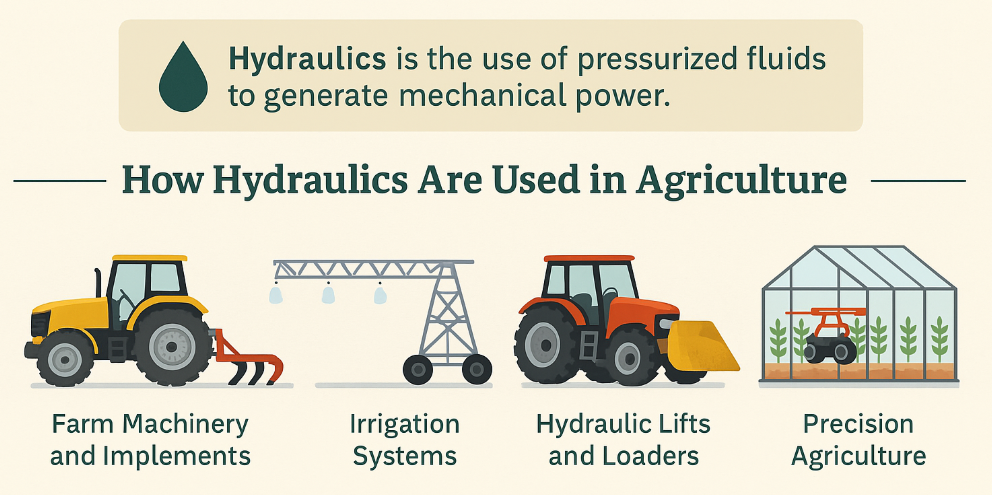
In agriculture, hydraulics are used to convert fluid pressure into useful mechanical force. This allows farm machinery to lift heavy implements, steer large vehicles, control attachments, operate harvesters, adjust sprayers, and power many other movements that would be difficult or unsafe to manage manually.
Hydraulic power is especially valuable in farming because it can deliver high force through compact components. This makes it ideal for tractors, loaders, harvesters, balers, seeders, sprayers, irrigation equipment, and automated systems used around farms, greenhouses, and barns.
2. Common Agricultural Uses of Hydraulics
Farm machinery and implements
- Tractors: power steering, brake systems, hydraulic linkages, and implement lifting.
- Harvesters and combines: header control, reel adjustment, conveyors, and unloading augers.
- Balers, sprayers, and seeders: compaction, folding booms, seed placement, lifting, and controlled distribution.
Irrigation systems
- Hydraulic systems can support pumping stations used to move large volumes of water.
- Pivot and drip irrigation systems may use hydraulic control for flow, movement, and pressure management.
Hydraulic lifts and loaders
- Front-end loaders use hydraulic cylinders to lift, tilt, scoop, and carry materials.
- Hydraulic systems help lift hay bales, soil, fertiliser, feed, grain, and other heavy farm materials.
Greenhouse and barn automation
- Hydraulic actuators can operate ventilation systems, roof openings, and wall panels.
- Hydraulics may also be used in feed delivery, manure scrapers, gates, and handling systems.
Precision agriculture
- Hydraulics can adjust machinery settings based on GPS, sensors, and control systems.
- This supports accurate seed depth, spray boom position, fertiliser distribution, and harvesting height.
3. Why Is Hydraulic Power Important for Modern Farming?
Hydraulic power is important for modern farming because it drives and controls many tasks that require strength, precision, and repeated movement. It helps farmers work faster, reduce manual labour, improve safety, and operate larger or more advanced equipment.
| Benefit | Why it matters on farms |
|---|---|
| Power and strength | Handles heavy loads using compact components, ideal for loaders, cylinders, and attachments. |
| Precision | Enables controlled movement for planting, spraying, harvesting, lifting, and adjustment. |
| Versatility | Can power many different machines, implements, and attachments from one hydraulic system. |
| Efficiency | Reduces manual handling, saves time, and helps complete more work with fewer passes. |
| Automation ready | Works with modern agricultural technology for variable rate seeding, spraying, and smart control. |
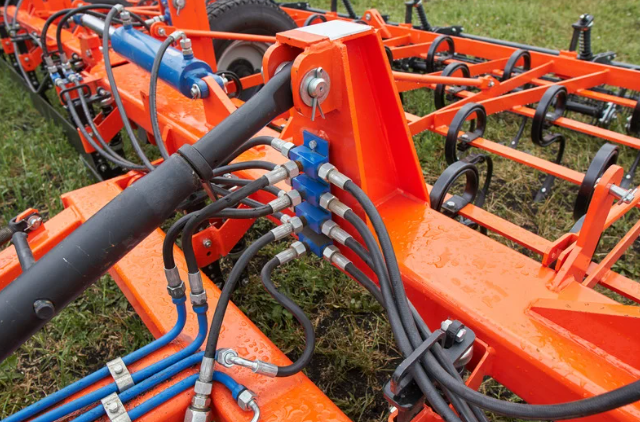
4. What Are the Main Components of a Hydraulic System Used in Farming?
Agricultural hydraulic systems use several core components to generate pressure, move oil, control flow, create movement, manage heat, and prevent contamination. The component names in the table link directly to the most relevant Flowfit product categories.
| Component | Function | Typical farming application |
|---|---|---|
| Hydraulic pump | Converts mechanical energy into hydraulic pressure by moving oil through the system. | Tractors, loaders, sprayers, tipping trailers, and hydraulic power systems. |
| Hydraulic oil | Transfers power while lubricating, cooling, and protecting components. | Tractors, balers, harvesters, loaders, and general agricultural machinery. |
| Hydraulic cylinders | Convert hydraulic pressure into linear pushing or pulling force. | Loader arms, tipping trailers, plough adjustment, gates, and lifting systems. |
| Hydraulic motors | Convert hydraulic energy into rotary mechanical movement. | Conveyors, spreaders, augers, harvesters, and driven attachments. |
| Directional control valves | Control the direction, flow, and operation of hydraulic functions. | Loader control, implement lifting, folding booms, trailers, and attachments. |
| Hydraulic tank | Stores hydraulic oil and helps with cooling, de-aeration, and fluid supply. | Power units, tractor systems, irrigation equipment, and custom machinery. |
| Hydraulic filters | Remove dirt, particles, and contamination from the hydraulic oil. | Protects pumps, valves, cylinders, and motors from premature wear. |
| Hydraulic hoses | Transport pressurised oil between hydraulic components. | Connects tractors, implements, cylinders, valves, and attachments. |
| Hydraulic oil coolers | Help regulate oil temperature during extended or heavy-duty operation. | Harvesters, loaders, power units, and equipment working long duty cycles. |
| Hydraulic adaptors and fittings | Connect hoses, valves, cylinders, pumps, and other components while maintaining pressure integrity. | Used across almost all agricultural hydraulic circuits. |
Selection tip
When replacing hydraulic components, match the original specification carefully. Pressure rating, flow rate, port size, hose size, oil compatibility, mounting, and machine requirements all matter.
5. What Farming Equipment Commonly Uses Hydraulics?
Hydraulic systems are used across a wide range of farming equipment because they provide strong, controllable movement in compact machinery. They are especially common where lifting, steering, folding, tipping, adjusting, or rotating is needed.
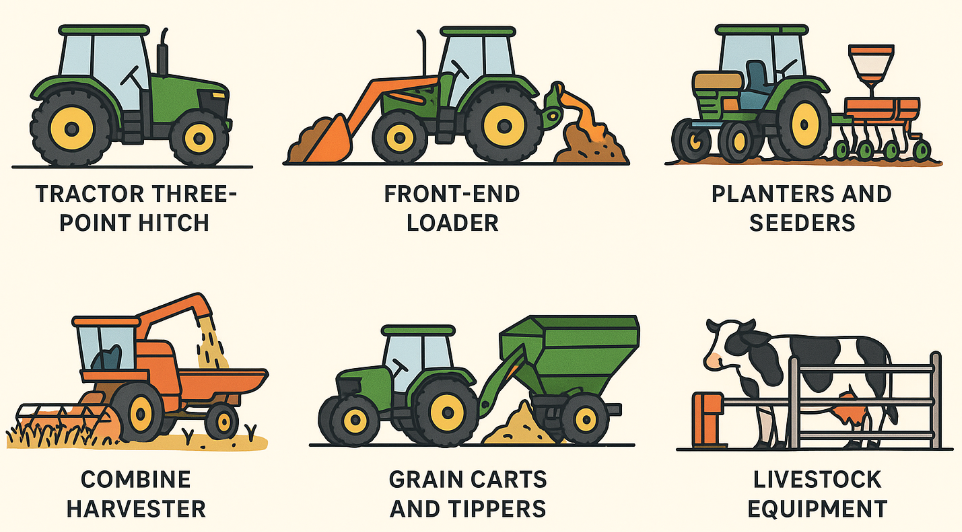
| Equipment | Hydraulic use |
|---|---|
| Tractors | Power steering, brakes, three-point linkage, loader arms, and attachment control. |
| Combine harvesters | Header adjustment, reel control, auger movement, conveyors, and grain tank operation. |
| Balers | Bale chamber control, pickup operation, compaction, ejection, and gate movement. |
| Ploughs and harrows | Blade adjustment, lift systems, folding sections, and depth control. |
| Seeders and planters | Seed depth adjustment, folding frames, lift systems, and precision control. |
| Sprayers | Boom folding, height control, pump drives, and spray position adjustment. |
| Loaders and backhoes | Lifting, scooping, digging, tilting, and attachment control. |
| Mowers | Deck height adjustment, arm movement, folding, and cutting unit positioning. |
| Manure and feed equipment | Conveyors, gates, scrapers, spreaders, and feed delivery mechanisms. |
| Irrigation systems | Pumping, pivots, valve operation, and movement control. |
6. How Do Hydraulic Systems Improve Tractor and Harvester Performance?
Hydraulic systems improve tractor and harvester performance by giving operators powerful, precise, and repeatable control over key machine functions. This helps improve productivity, safety, crop handling, and operator comfort.
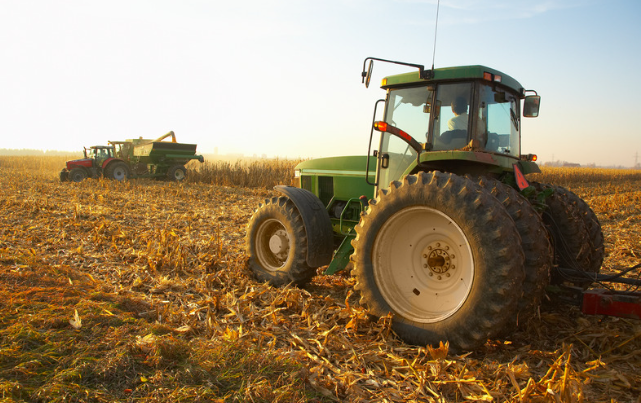
| Function | Hydraulic benefit | Equipment |
|---|---|---|
| Power steering | Smoother manoeuvring and reduced operator effort. | Tractors and harvesters |
| Brake systems | Improved stopping control when carrying or pulling heavy loads. | Tractors |
| Three-point hitch | Easy lifting, lowering, and adjustment of implements. | Tractors |
| Loader and bucket operation | Controlled lifting, digging, scooping, and tipping. | Tractors and loaders |
| PTO and transmission support | Smoother power control for attachments and driven tools. | Tractors |
| Header and reel adjustment | Accurate harvesting height and crop handling. | Harvesters |
| Auger and grain tank control | Efficient unloading and controlled movement. | Harvesters |
| Internal harvesting mechanisms | Crop-specific adjustment for improved harvesting performance. | Harvesters |
7. How Do You Maintain Hydraulic Systems in Agricultural Machinery?
Maintaining hydraulic systems in agricultural machinery is important for performance, safety, and equipment lifespan. Farm hydraulics often work in dusty, wet, hot, and high-load environments, so regular inspection and clean servicing habits are essential.
Quick maintenance tips for farm hydraulics
- Check hydraulic oil levels regularly and top up with the correct oil.
- Inspect for leaks around hoses, seals, adaptors, cylinders, valves, and fittings.
- Replace filters at the recommended service interval, or sooner in dusty conditions.
- Examine hoses and seals for cracks, bulging, abrasion, hardening, or damage.
- Monitor pressure and temperature to identify overheating or abnormal system behaviour.
- Bleed the system after maintenance where required to remove trapped air.
- Keep ports and oil clean by wiping connections, capping hoses, and using sealed containers.
Preventive maintenance helps reduce breakdowns during busy periods such as planting, spraying, harvesting, and feeding. Clean oil, good filtration, correct hose condition, and leak-free fittings are especially important for reliable farm machinery.
8. What Challenges Do Farmers Face with Hydraulic Equipment?
Hydraulic equipment is powerful and versatile, but it needs correct setup and maintenance. Common problems such as leaks, contamination, hose failures, overheating, and air in the system can quickly affect productivity.
| Challenge | Effect on farm operations | Relevant component |
|---|---|---|
| Fluid leaks | Loss of pressure, messy operation, safety hazards, and wasted oil. | Hydraulic adaptors and fittings |
| Oil contamination | Increased component wear, blocked valves, pump damage, and shorter oil life. | Hydraulic filters |
| Hose and seal failures | Downtime, sudden loss of function, and potential safety risks. | Hydraulic hoses |
| Overheating | Oil breakdown, reduced efficiency, seal damage, and possible shutdowns. | Hydraulic oil coolers |
| Air in the system | Jerky movement, noise, poor response, and cavitation risk. | Hydraulic tanks |
| Incorrect oil choice | Poor lubrication, sluggish performance, overheating, or premature wear. | Agricultural universal oils |
9. Why Buy Agricultural Hydraulics from Flowfit?
Flowfit supplies hydraulic products for agricultural machinery, mobile equipment, workshops, and custom hydraulic systems. Whether you are repairing a tractor, maintaining a loader, upgrading a hydraulic circuit, or replacing worn components, Flowfit can help keep your equipment running reliably.
- Comprehensive agricultural hydraulic range
Shop hydraulic pumps, agricultural oils, cylinders, motors, valves, tanks, filters, hoses, coolers, and adaptors. - Hydraulic expertise
Flowfit’s team can help identify suitable components for farming, mobile, and industrial applications. - Durable components for demanding work
Choose hydraulic parts designed to support reliable performance in tough operating conditions. - Free UK shipping over £99.99
Flowfit offers free UK shipping on eligible orders over £99.99. - Global shipping
Serving customers across the UK and worldwide.
Shop agricultural hydraulic components
Browse popular Flowfit components for farm machinery maintenance, repairs, and hydraulic system builds.
For pressure generation in tractors, loaders, sprayers, and power systems.
For lubrication and hydraulic system performance in agricultural machinery.
For lifting, pushing, pulling, tipping, and attachment movement.
For controlling lift, lower, extend, retract, and attachment functions.
For reliable oil transfer between pumps, valves, cylinders, and attachments.
Ask our hydraulic specialists for help finding the right product for your machinery.
Tip: Before replacing hydraulic components, check pressure rating, flow rate, port sizes, thread types, hose sizes, oil type, mounting dimensions, and the machine manufacturer’s specification.
The total one-stop supplier for hydraulic components & systems
Get in touch

Parys Road
Ludlow
Shropshire
SY8 1XY


